How to avoid altitude sickness in Cusco and Peru!
Altitude in Cusco can lead to altitude sickness, also known as Acute Mountain Sickness (AMS), which is something that Sara and I believed we wouldn’t have to worry about. We’re young, we’re healthy, we train at the gym regularly, we should be okay right?
We were categorically wrong.
Neither of us had been at a particularly high altitude before. We’ve both skied in the alps at around 2300m (7550ft) without any altitude issues, but that’s as high as we ever got.
However, after flying from Lima (which is at sea level by the way) to the Andes, the altitude in Cusco absolutely kicked our butts!

In this guide we want to cover our experience of dealing with altitude in Cusco. In addition, we’ll cover all things preventative, things we didn’t do, that you can do to prepare for your trip to Cusco!
Note: although Ryan has a degree in Biology, this is not professional medical advice, only what we’ve learned through our own research during our trip. If you want accurate information, please seek advice from a registered doctor.
This post may contain affiliate links. Please read our Disclosure Policy.
What is the altitude in Cusco?
If you don’t already know, Cusco sits at a whopping 3399m (11,000ft) above sea level. So we’re going to start by putting the altitude in Cusco into perspective.
Here are some points of reference:
- Ben Nevis (1345m / 4412ft) – the tallest mountain peak in the UK.
- Denver (1609m / 5280ft) – the mile high city.
- Grand Canyon (2074m / 6804ft) – one of the most popular tourist destinations in the US.
Mount Everest, the tallest point on earth, sits at 8849m (29,032ft), which makes Cusco a third of the altitude.
Pretty tall right?

Most commonly, altitude sickness starts to occur around altitudes above 2400m (~8000ft). That kind of explains why Sara and I never felt the effects while skiing! But it also goes to show why so many people succumb to altitude sickness in Cusco.
Why does altitude sickness occur?
Due to lower levels of pressure at higher altitudes, air tends to expand which means there is less opportunity for particles to clash together. As a result, oxygen becomes much more spread out leading to less being available for us to breathe.
As a result, when we as humans ascend too fast without acclimatizing, we struggle with the lack of oxygen for our respiratory system. Our brains then go into flight or fight mode which manifests as physical symptoms.
What does altitude sickness feel like?
Altitude sickness causes symptoms of varying intensities. For Sara and I, even a short walk would cause us to develop headaches, dizziness and tiredness. I’m not sure if it’s a sign of the altitude, but sometimes I would start to get pins and needles in my legs when walking.
Our symptoms were fairly mild though. Stronger symptoms may leave you feeling nauseous, with high levels of fatigue and a loss of appetite.
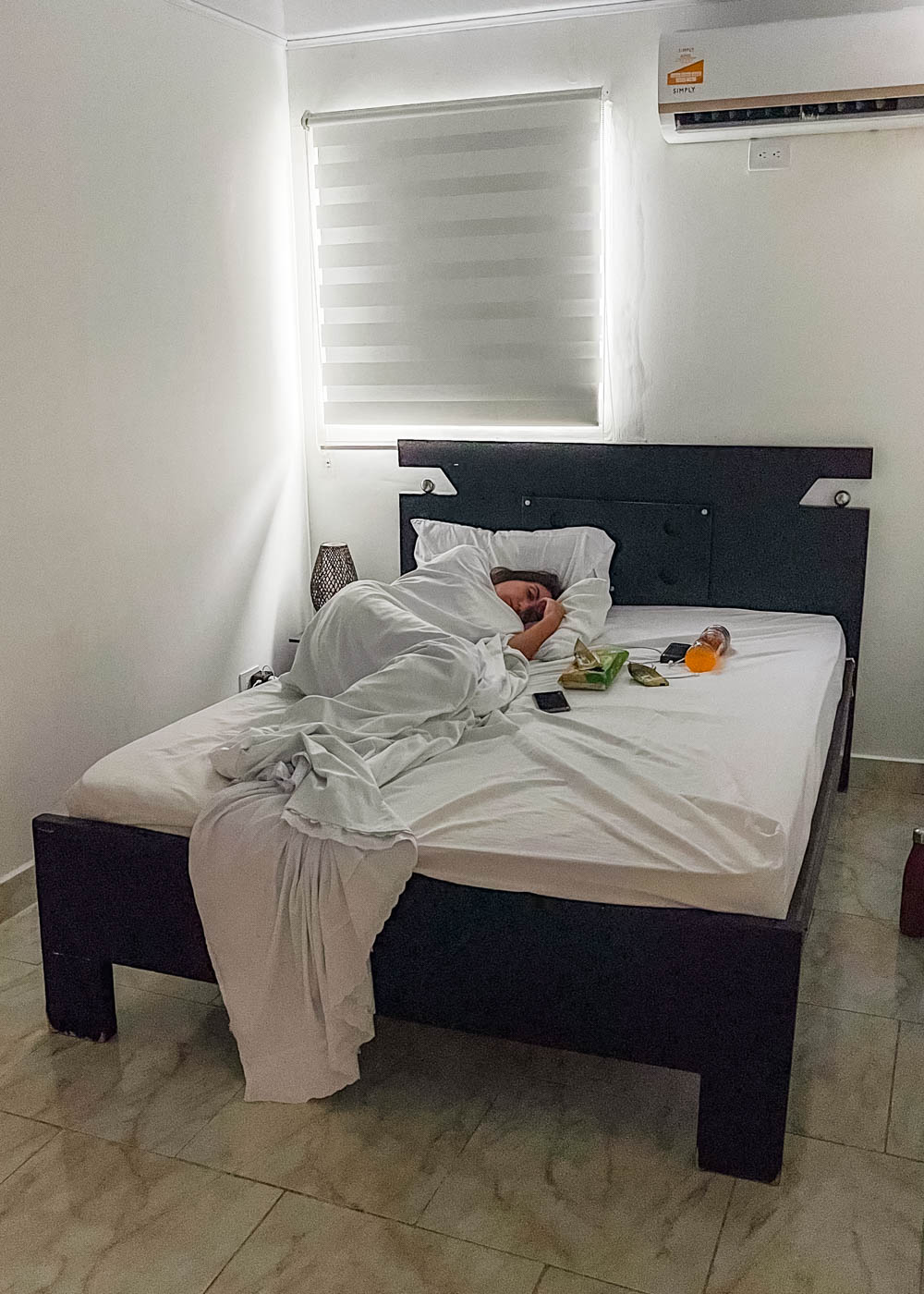
The worst symptoms you may face are things like insomnia, vomiting and lethargy. If symptoms like this persist for longer than a couple of days, it’s definitely time to seek help from a doctor.
In very rare cases, serious altitude sickness can lead to death. But we don’t want to scare you as it almost never gets to this. Especially at 3400m (11,150ft) in Cusco. That’s more of a Mount Everest issue.
Preparing for altitude sickness in Cusco before you trip
If you’re planning to head to Cusco soon, and you’re going to be ascending from lower altitudes, here are a few things you can do prior to your trip to hopefully negate the effects of altitude sickness.
Preventative medicine
There are a few medications that you can start taking before your ascent to prevent altitude sickness. These are also similar to the medications you could take whilst also acclimatizing. Sara and I personally try to avoid taking pills unless absolutely urgent, but if you’re worried about altitude sickness this might be a great way to go.
Consider taking acetazolamide (Diamox), which is a diuretic used to treat the symptoms of altitude sickness. If taken within 48 hours before climbing to higher altitudes, it could help pre-treat the symptoms.
Ibuprofen can be taken to help prepare for the head and body aches that are related to altitude sickness. And it’s always useful to have some ibuprofen or paracetamol on hand anyway!
Don’t forget travel insurance!
Sara and I have been using Safety Wing for over two years now! They specialise in nomad travel insurance, so whether you’re travelling long-term or on a short trip, they got you covered!
Start exercising a little
Symptoms of altitude sickness manifest because our body struggles to carry out regular respiratory functions with low volumes of oxygen. However, the better your cardiovascular system can utilize oxygen, the less effects you’re likely to experience.
Therefore, if you’re not usually an active person in your day to day life, it could be a good idea to start exercising. Just simple things such as hitting 10,000 steps a day, or taking the stairs instead of the elevator can help.

Plan to elevate gradually
One of the best ways to avoid altitude sickness is to ascend to higher elevations slowly. This is common practice for climbers aiming for high mountain peaks, but it could help you too.
If you’re heading to Cusco, then why not consider stopping at Arequipa along your route?
Arequipa is a great stopping point at 2,335m (7660ft), just below the elevation that people start to feel the effects of altitude. Plan a week exploring Arequipa and you’ll be much more equipped to handle the height of Cusco.
Plan some flexibility in your schedule
When putting together your itinerary, consider adding some flexible “spare” days at the beginning of your plans. This way if you are unfortunate enough to succumb to altitude sickness, you can use these spare days to acclimatize before continuing with your main plans.
Consider past experiences with altitude
If you’ve been to areas of altitude before, especially if it was over 2,400m (7874ft), then refer back to your past experiences.
If before you were completely fine with altitude, the chances are you’re going to cope fine with Cusco’s altitude. However, if you felt sick last time, you probably will again.
Dealing with the altitude in Cusco
Let’s say that you’ve tried all the preparative measures we’ve mentioned above, you’ve arrived in Cusco and you still feel altitude sickness?
Well there are a few things to consider to try to fight or dull the symptoms. Most of the below we actually used when we felt sick!
Take plenty of rest to acclimatize
Our number one tip that worked best for us is just to rest up. If you feel like taking a nap, then take a nap. If you just want to lay in bed and watch Netflix, then do that!
For us, as soon as we started to feel the symptoms of altitude sickness in Cusco, we just canceled all our plans for the next few hours and watched a movie. We were able to do minor exercise for a short period of time, then we’d head back to the Airbnb and chill out.
If you do want to head out, maybe consider tackling some of the more easy going things to do in Cusco while acclimating, before climbing too many hills.

Stay hydrated
Being dehydrated is THE WORST when it comes to altitude sickness. Any normal person gets a headache when they’re dehydrated at best, but imagine that and the fact your brain can’t get enough oxygen.
What we did was always carry a water bottle around wherever you go and remember to take regular sips. We’d highly recommend this and we think it was a great way we prevented our symptoms getting any worse!
Chew coca leaves or drink coca leaf tea
Something that would most likely be highly illegal in your home country, is to chew coca leaves or brew coca tea.
Coca leaves contain a natural stimulant that boosts energy levels and reduces hunger. We saw locals everywhere chewing coca leaves and not because of the altitude, but because they just enjoy it.

We opted to brew coca tea with our leaves. Essentially, we boiled water and poured it into a pot with a handful of leaves. We left it to brew for about 10-minutes and then poured it out to enjoy a cup of tea!
We usually feel the symptoms of altitude sickness abate around 15-minutes after drinking the tea.
Take sickness medication
In general, the same medication we covered earlier is the same as what you’d take with altitude sickness. Just one extra option we’d like to add that we took advantage of is your standard motion sickness pills.
Overall, motion sickness pills aren’t going to get rid of altitude sickness, but it will mitigate your nausea for a period of time.

Limit strenuous exercise
In a similar vein to taking a rest, try not to undergo too much strenuous exercise. By strenuous exercise, in this sense we mean even walking uphill. We found walking back to our Airbnb from the city center to be pretty strenuous.
Instead, keep exercising to a minimum in general. And if you start to feel nauseous while out and about, stop and take a few deep breaths and then head home and take a break!

Avoid smoking
This one is kind of self explanatory in our opinion. Sara and I personally are non-smokers, but if you do smoke, the lack of oxygen from the altitude combined with the carbon monoxide you’re inhaling isn’t going to do you any favors.
Obviously if you’re a smoker you’re not going to be able to just stop. However, you might want to limit smoking to only when you’re not walking or planning to walk anywhere.
And just be careful. If you’re smoking and you feel faint, it’s probably best to stop.
Consider descending in altitude
If you’ve tried all of the preventative methods, all of the coping methods and you’re still feeling super ill, it might be time to consider descending to a lower altitude. At the end of the day, every person is different and altitude might just not be for you.
What you can do is head back down until you feel better (which will almost be instantaneous), wait to acclimatize for a few days and try again. In the case of Cusco, we would recommend descending back to Arequipa.
Consult a doctor
Lastly, if you’re all out of options and you have no choice but to stay at altitude, then consult a doctor. Maybe they’ll have some prescription meds you can try or some other method to deal with the symptoms.
Check out our other Cusco guides:
- Is Cusco safe to visit in 2024? Everything you need to know
- What’s the rainy season in Cusco like? – Peru Travel Guide
- Cusco Weather in January: A good time to visit?
- Cusco in December: Weather, celebrations, things to do and more!
- Spending Christmas in Cusco: Things to do and how to celebrate!
- Visiting the Temple of the Moon in Cusco: Everything you need to know!
- One day in Cusco: The perfect 24 hour itinerary!
- 2 Days in Cusco: The best way to see everything quickly!
- 3 days in Cusco – a full itinerary and everything you need to know!
- 4 days in Cusco: A full itinerary and everything you need to know!
- 16 Completely FREE things to do in Cusco!
We hope that our guide covered everything you need to know about Altitude in Cusco. We always strive to offer the most accurate and up-to-date information we can but if you think something we’ve said is wrong, please let us know!